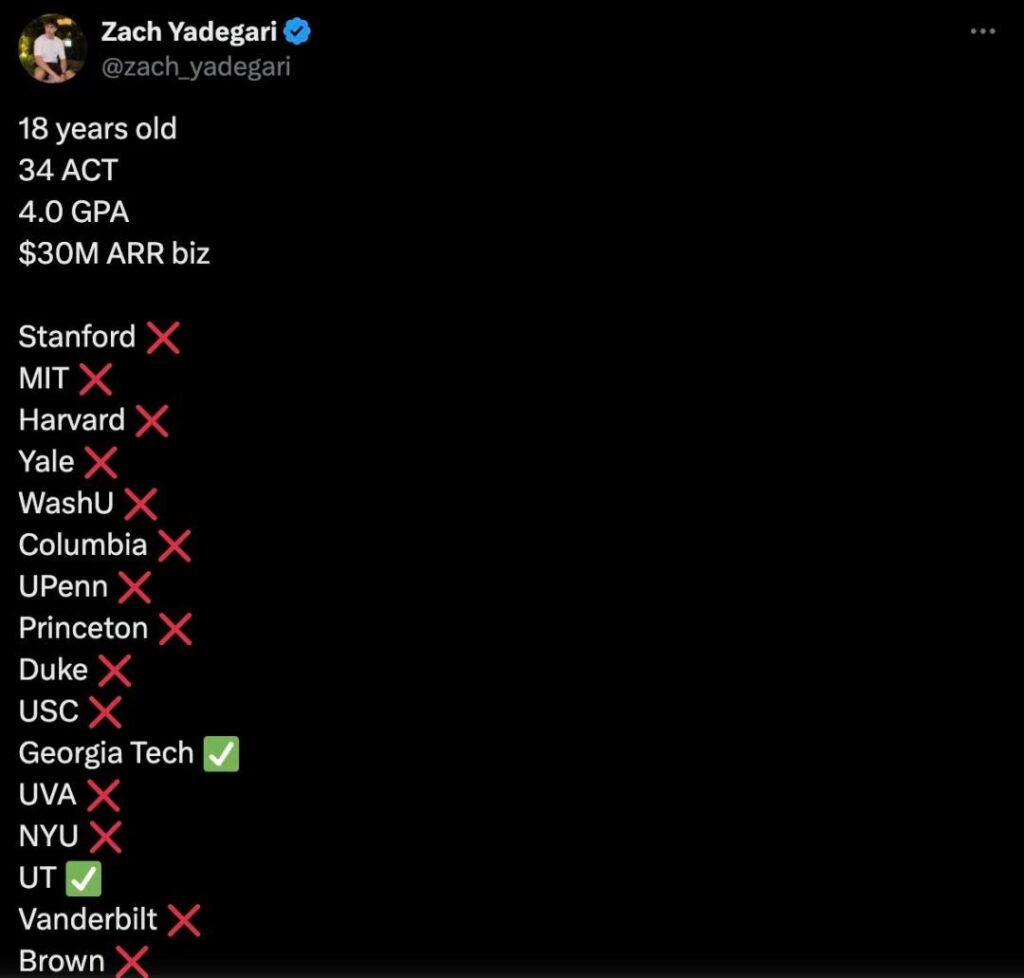
When 18-year-old Zach Yadegari posted 15 rejection letters from top universities on social media, the entire education community was thrown into an AI mixer – after all, this CEO with an annual income of $24 million, But even the Reddit co-founders couldn’t help shouting: ” Did this admissions officer collectively eat an AI-generated rejection template? ”
The “reverse” life of a brilliant student
If the college application is compared to “Squid Game,” Zach should have been the player with a VIP pass: his 4.0 GPA put him in the top 1% of his grade。ACT score of 34 points (full score of 36) directly crushed 95% of the candidates, not to mention the achievements on his resume that make workers cry – selling the first startup at the age of 16, making the phenomenon AI application with 3 million downloads at the age of 18, annual revenue of 176 million yuan.
However, the reality has staged a magical reversal: MIT, Stanford, Harvard, and 15 other top universities collectively showed the red card, and only three strong engineering schools, such as Georgia Tech, reluctantly handed over tickets.
This scene is comparable to the game’s full-time boss being attacked by SLM in the village of novices, so it’s no wonder that netizens are beginning to wonder whether the Bitcoin virus has hit the Ivy League admissions system.
The “cash power” code for calorie counting
To understand this storm of rejection, look at Zach’s empire of heat and economics. He released the Cal AI application in his senior year of high school, which uses AI to identify food pictures and calculate calories.
It sounds like a digital scale for salad lovers, but it turns out to be a money-making machine – Anthropic and OpenAI models, with 90% accuracy on GitHub’s open source database, can’t even hide half a fish ball in the bottom of a bowl of instant noodles.
The secret to this app’s success can be described as the “cleaning of the cow” in the circle of technology: while others use AI to write poems and draw pictures, Zach prefers to teach AI to count the calories of broccoli.
What’s even more infuriating is that this is his second cash-out in a startup – the operation of selling a web game company at the age of 16 has made many workers lament, “I was still stealing my parents’ credit cards to top up the game when I was 16.”
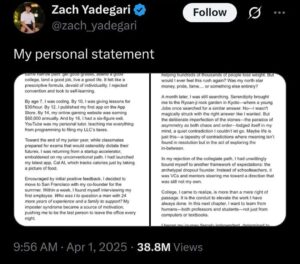
When Zach published the controversial document, which prompted 27,000 retweets, the entire American education system suddenly learned what it means to be sincere.
The article began with a blistering tirade: “I texted my mom in 2019: I’ll never go to college,”Then he counted the rebellious years when he made apps in his hacker apartment in San Francisco and was treated like a baby by the venture capitalists.
But at the end, the style of painting suddenly changed. In the same Kyoto Ryokan temple as Steve Jobs, he.
The magical realism of this hybrid of “The Sorrows of Young Werther” and “The Biography of Steve Jobs” has the admissions officers collectively asking themselves three philosophical questions:” Is this kid coming to school or to make a documentary? “Does he really need a diploma, or does he come to school to find entrepreneurial inspiration?”
What’s even better is the declaration at the end of the article: ‘If you go to college, you want to live a social life like ‘Dance Youth’ for four years’,” turning the ivory tower directly into a large reality show set.
The Internet user’s microscope party
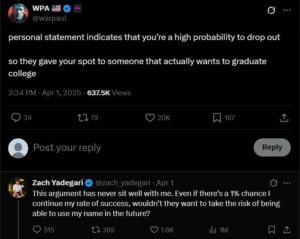
When the essay exploded on social media, the comment section instantly became the set of “Black Mirror”:
The Pie
Conspiracy theorists
Deep in Realism
“I suggest buying the university directly as a trustee so you can pay the professors.”
In the face of the soul-searching question of the netizen, “What is the point of going to school when you are financially free?” Zach’s reply can be described as the new height of Versailles: “I just want to experience theBreakfast Club“”This answer makes the workers collectively break the defense – we squeeze our heads to take the college entrance exam is to find a job, you old man is purely to play the campus simulator?
The disbelief storm unexpectedly brought more “coalitions of complainants.” Stanley Zhong, a 19-year-old Chinese-American student, has just taken the University of California to court, accusing Asians of discrimination – he scored 1590 on the SAT (out of 1600), had a Google offer, and was turned away from 16 universities.
Y Combinator CEO Garry Tan revealed his dark history: “When I was obsessed with Fountain of Youth rewrite documents, I was rejected by many schools, and Stanford finally took me in。”
These cases pieced together a grotesque picture that made college admissions standards the contemporary Da Vinci Code. Is it Asian discrimination? Is the entrepreneurial experience a drag? Or did the philosophical reflections in the texts strike a foul taste?
Admissions officers themselves may not be able to explain it – after all, they have to review 80,000 applications in 4 minutes, and the process is comparable to AI random drawing.
When Zach calmly states that “the reason for rejection is always a mystery,” the farce has long transcended personal success. It tears away the glossy veneer of the education system: Here, a 4.0 GPA may not be as compelling as a “How I Saved an African Orphan,” and business success is the original sin of not being pure enough.
The most ironic thing is that when Cal AI uses algorithms to calculate the calorie intake of millions of users, its creator is calculating the energy gap between ideals and reality.
Perhaps, as the netizens commented, ” The Ivy is not the end, but an achievement in Zach’s game of life that he can’t be bothered to unlock. ”
The ultimate thought behind this real-life sequel to The Social Network may be: When an 18-year-old is already living like someone else’s 40, how should the ivory tower embrace these “mature apples”?
After all, in an era when AI is disrupting everything, perhaps universities need to think more about how to avoid being trapped by their own traditional algorithms.